
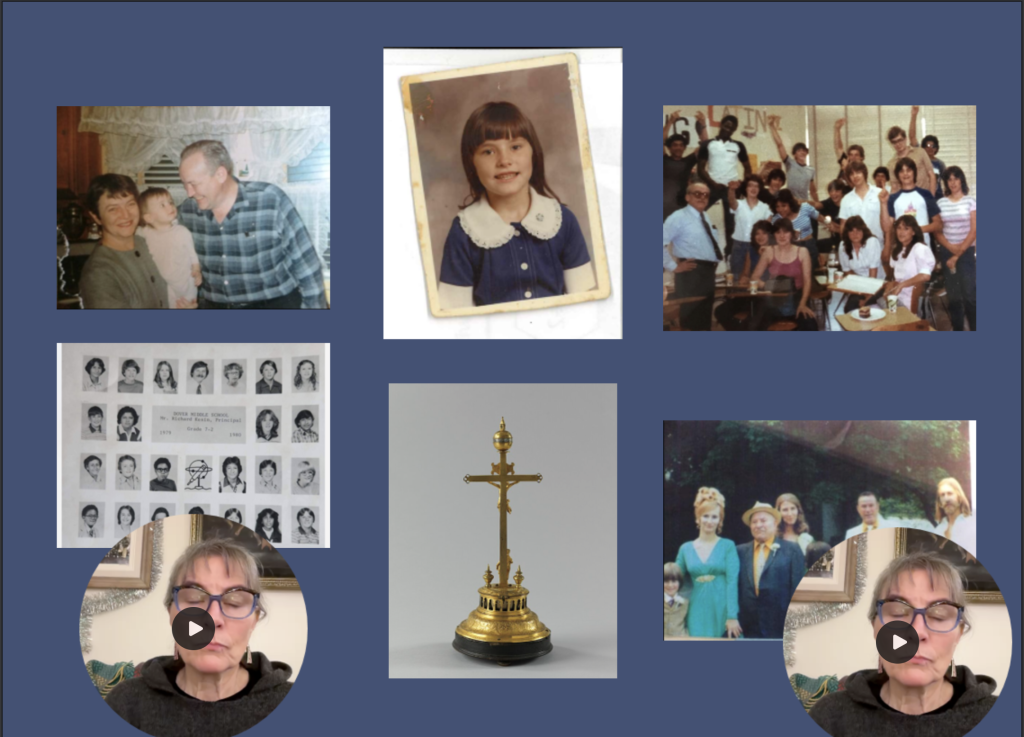
Assignment: You will conduct an autoethnography about the forces that shaped your understanding of race and culture.
Autoethnography
The forces that Shape Our Understanding of Culture and Influence Our Interactions with Folks from Different Cultures
Personal Qualitative/Arts-based Research
Ethnography: scientific description of the customs of individual peoples and cultures. This helps give us a lens into the personal qualitative research we will do in our autoethnographies about the forces that shape our understanding of race and culture.
Autoethnography, according to Oxford Reference online, is “the use of personal experience as data in the study of a selected topic such as socialization.”
Socialization is the activity of mixing socially with others (thank you, the Internet). Autoethnography is intended for our needs to be a reflective practice to begin our journey into self-awareness.
We will each create an eight-slide slideshow or equivalent (this can be an art project too) to share with our cohort on Saturday, January 20th. Knowing that some folks may need to or want to share their slides in a smaller group, there is another opportunity to share your projects Monday, January 22nd 3:30-5:30. I am hoping that Saturday works for most of us. Sharing our stories together is a powerful practice and being part of experiences like these lifts us all.
Michelle Amato will be available for digital office hours on January 8th between 3:30-5:30 in case there are any ideas or questions you would like to toss around.
Suggested Slide Parameters
The following are questions you can ask yourself to get started when researching and writing your autoethnography. Remember that you are researching yourself, so you have everything you need. Be brave, work hard. Please know this is an open-ended assignment, you are not required to answer these specific questions. You are certainly welcome to use them if they make sense to you in their entirety or otherwise.
Slide 1: Where were you born? Do you have siblings? Parents? -or- What was your family structure?
Slide 2: What shaped your ideas about your own race and culture? How did this or these experiences start to shape your attitudes and ideas about others? When did you first notice that people were different from you?
Slide 3: If there weren’t any experiences that shaped your ideas about race and culture, tell us about them.
Slide 4: Has race or culture created complications or complexities in your relationships with others? Do you ever find yourself conflicted about race and culture? Where were you or where are you when this is happening?
Slide 5: What calls you to this work? Why are you in this workshop?
Slide 6: What do you see in yourself that you are proud of?
Slide 7: What do you strive towards on behalf of your students? What legacy do you hope to leave when you transition out of your current role in education?
Slide 8: What new self-awareness have you gained through the work on this autoethnography? (It is optional to share this slide, but I suggest you do the work for your own reflective process.)
The art and skill of putting together a brief slide show is good practice. Each slide should contain pictures, text box inserts, and other graphics. Your research findings should be written in the slide notes. There is a limited time to present, each person will have 10 minutes. I will remain uncompromising about the timing for each presentation. Considering the transitions and glitches of 16 or more participants our time will go very quickly. I suggest that you write your slide notes, so they can be used as a sort of script. Remember not to make your slides too text heavy. Slides are intended to communicate information using pictures, small text boxes, and other graphics. Hearing your voice tell the story rather than reading the words on the slides will help us understand. I am eagerly looking forward to January 20th.
Note from Michelle
I first had the pleasure of writing an autoethnography during the summer of 2020 in a Multilingual Writing Class. The assignment asked a group of teachers to conduct personal research into our own literacy development, and frankly, even something as commonplace as writing about literacy in a class full of teachers felt daunting. This autoethnography will not be easy to write. I understand this, so I am hoping that the open-ended aspect of the research along with a few parameters will help you feel more successful than I did my first time. I have written two autoethnographies and in this class, I will write a third. The reason I am asking this be done for the PINE Project, is because of the reflective nature of the practice and because each time I wrote an autoethnography I learned more about myself and why I am called to do this work. Through an inspection into how or why we have adopted the attitudes that we have about culture, race, and our sense of belonging we will find ourselves better grounded in our own self-awareness. When we are comfortable in our own skin, we can help others feel that way too.

